

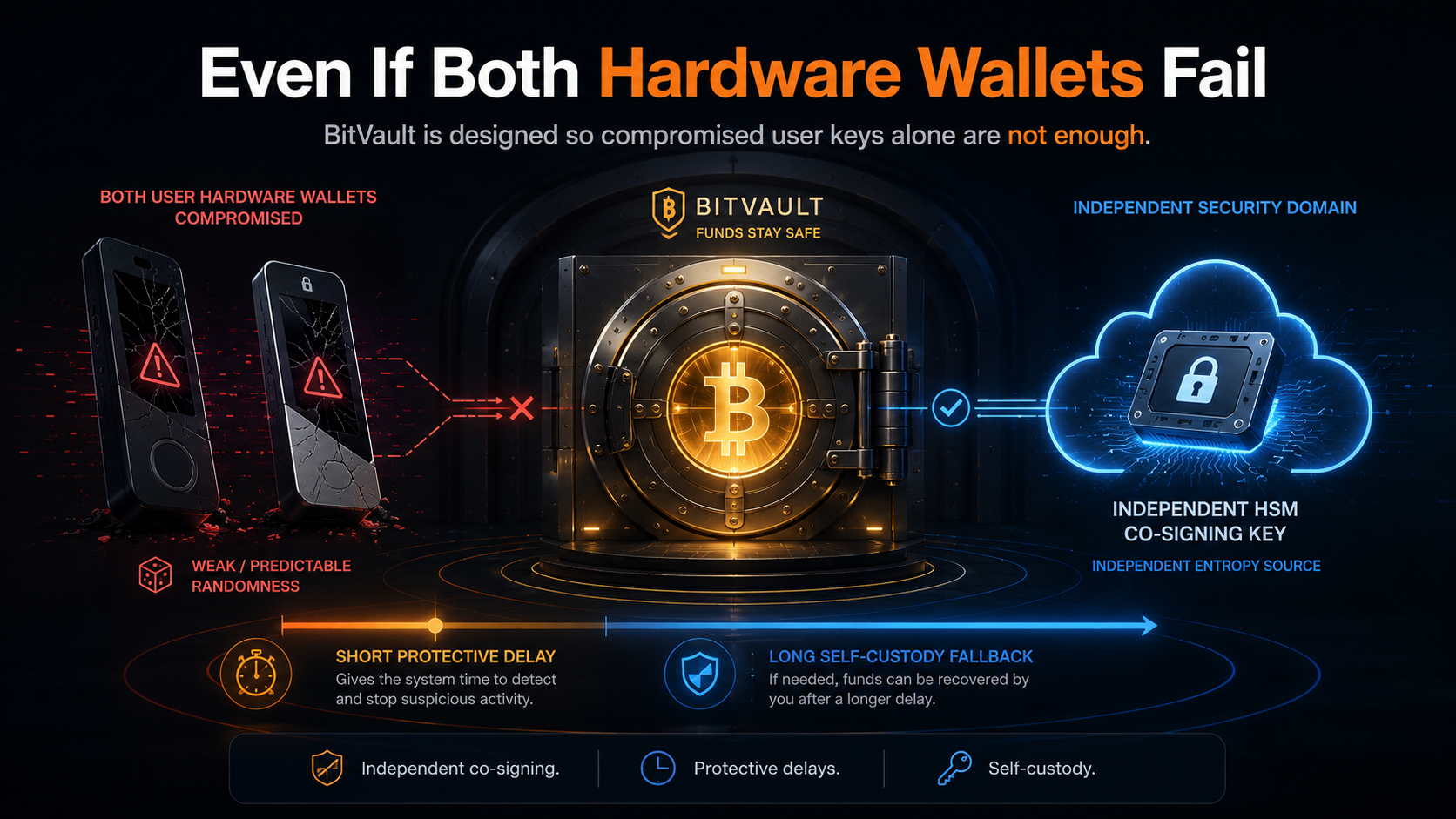
Even If Both Hardware Wallets Fail, BitVault Is Designed to Keep Your Bitcoin Safe
The recent hardware-wallet RNG failures exposed a serious weakness in traditional self-custody:
You can protect your seed perfectly, follow every instruction and still be exposed if the device generated a predictable private key.
With a standard single-signature wallet, defective randomness can mean immediate loss.
With an ordinary multisig setup, generating multiple keys on hardware affected by the same flaw may compromise enough keys to satisfy the spending threshold.
BitVault is designed differently.
Both user keys can fail—and still not be enough
On a 2-of-3 multisig A,B (user keys) and C keys (convenience service’s key), BitVault separates normal protected spending from long-term self-custody recovery:
- Protected spending:
(A or B) + C, with a short protective delay. - Self-custody fallback:
A + B, available only after the long one-year delay.
This means that even if the entropy of both user hardware wallets fails and an attacker reconstructs both A and B, the attacker still cannot use BitVault’s normal protected spending path.
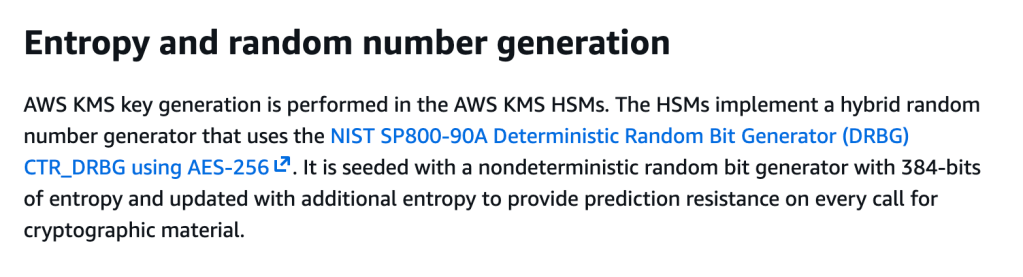
That path requires C: an independently generated BitVault co-signing key protected inside AWS KMS HSM infrastructure.
The compromised user keys are limited to the long-delay fallback path which never reaches maturity , because the user can move first, by just using its Protected Spending path (A or B) + C , with a short protective delay.
Time prevents compromised keys from becoming spendable
BitVault users refresh their protected UTXOs before the one-year fallback path matures.
Each successful refresh creates a new BitVault output and restarts the long-delay countdown.
The result is:
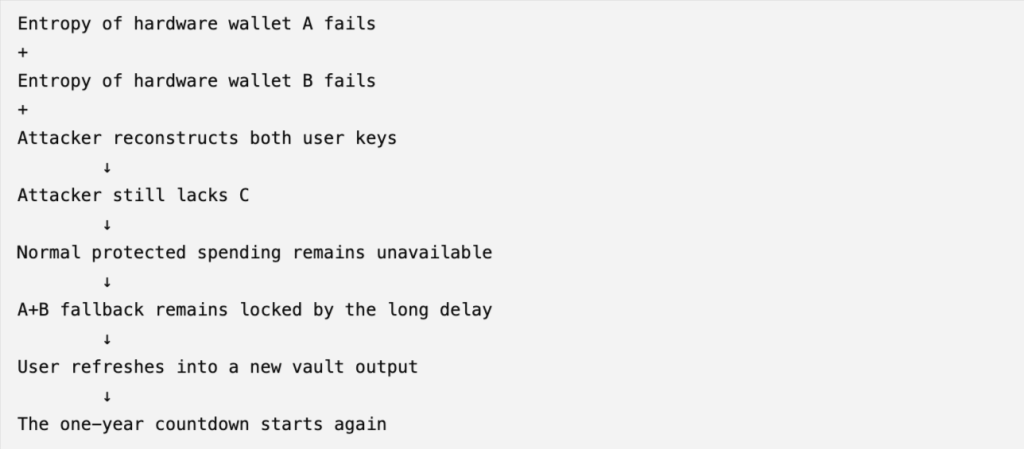
Provided the prescribed refresh procedure is followed and C remains secure:
The entropy failure of both user hardware wallets is still not enough to steal the funds.
That is the strategic difference.
An independent entropy domain
In BitVault’s managed configuration, C is not generated by either user hardware wallet.
It is generated and protected within AWS KMS HSM infrastructure using an independently operated entropy and key-generation system.
Therefore, the vault does not depend on:
- one hardware-wallet manufacturer;
- one firmware implementation;
- one Secure Element;
- one consumer-device entropy pipeline;
- or even the combined reliability of both user devices.
A vulnerability affecting both user hardware wallets does not automatically compromise the independent BitVault signing domain.
BitVault makes hardware failure insufficient
Traditional self-custody asks:
Can you trust your hardware wallet’s randomness?
BitVault asks a better question:
Why should the failure of one—or even two—consumer devices be enough to lose everything?
BitVault combines:
- two user-controlled hardware-wallet keys;
- an independently generated HSM-protected co-signing key;
- separate short- and long-delay signing paths;
- periodic UTXO refreshes;
- a provider-independent self-custody fallback.
The objective is not to claim that hardware wallets can never fail.
It is to make their failure insufficient.
With BitVault, even the entropy failure of both user hardware wallets is not, by itself, enough to lose the bitcoin.
Check it out on:
Beyond Keys. Protecting Humans.