


Multisig and Descriptor Backups Explained
Managing Bitcoin securely requires more than just a seed phrase. Multisig wallets and descriptor backups are key tools for protecting your funds and ensuring recovery. Multisig wallets require multiple private keys to authorize transactions, making them safer against theft or loss. Descriptor backups store your wallet’s setup details, like address generation rules and co-signer keys, ensuring you can fully recover your wallet even in complex setups.
Key Takeaways:
- Multisig Wallets: Add security by requiring multiple signatures (e.g., 2-of-3). Even if one key is lost, funds remain accessible.
- Descriptor Backups: Store critical wallet details (e.g., xpubs, derivation paths) needed for recovery, especially for multisig or cross-chain setups.
- Recovery Essentials: You’ll need seed phrases, the output descriptor, and co-signer information for a successful recovery.
- Backup Methods: Options include paper/digital storage, steel engraving, or encrypted on-chain backups.
- Common Mistakes: Believing seed phrases are enough, losing descriptors, poor backup strategies, and failing to test recovery.
Pro Tip: Tools like BitVault simplify descriptor backups by encrypting and storing them on the Bitcoin blockchain, ensuring accessibility and security.
Keep reading for step-by-step recovery instructions, inheritance planning tips, and a comparison of backup methods.
Bitcoin Seed Backups for Multi Sig with SeedHammer (SLP 532)

What You Need for Multisig Recovery
Recovering a multisig wallet is more involved than dealing with a single-signature wallet. It requires more than just a seed phrase, and overlooking even one key element can result in losing access to your Bitcoin permanently. Knowing exactly what you’ll need ahead of time can help you avoid costly mistakes. Here’s a breakdown of the essential components for a successful recovery.
Required Components for Recovery
Unlike single-signature wallets, seed phrases alone won’t cut it for multisig recovery. You’ll need a combination of specific components to fully reconstruct your wallet’s structure.
The first piece of the puzzle is the threshold number of seed phrases. For example, in a 2-of-3 multisig setup, you’ll need at least two of the three seed phrases to authorize transactions. Similarly, a 3-of-5 setup requires three seed phrases. These seed phrases generate the private keys that are essential for creating valid signatures.
But seed phrases are just one part of the equation. The output descriptor is equally critical. This descriptor acts as a technical guide, providing all the details necessary to reconstruct your wallet’s multisig setup. It includes information like derivation paths, extended public keys (xpubs) from all co-signers, the type of script used, and the threshold requirements.
"Many new users aren’t aware that in order to recover a 2-of-3 multisig wallet, you need at least 2 seed phrases and the output descriptor. Among other things, the descriptor contains the derivation paths and the extended public keys (xpubs), all of which are needed in order to spend from a standard 2-of-3 multisig."
– josh
These components are essential not just for regular wallet recovery but also for cross-chain recovery scenarios and inheritance planning.
Common Recovery Mistakes
Being aware of common pitfalls can save you from making irreversible errors when recovering your multisig wallet.
One frequent mistake is believing seed phrases alone are enough. This misunderstanding often comes from single-signature wallet users, where a seed phrase contains everything needed for recovery. In a multisig setup, you need both the cryptographic keys (seed phrases) and the structural data (output descriptor).
Another common error is losing or damaging the output descriptor. Storing descriptors on laptops, in cloud storage, or on USB drives might seem convenient, but these methods come with risks. Hard drive failures, accidental deletions, cloud service outages, or USB corruption can easily result in the loss of this critical information.
Poor backup strategies for descriptors also create vulnerabilities. For instance, printing descriptors on paper risks fading, fire damage, or becoming unreadable over time. While engraving them on steel plates is more durable, it can be expensive and tricky when planning for inheritance.
Some users also run into trouble by mixing up derivation paths or script types during recovery. This can make your funds seem inaccessible, even when they’re still there.
Another major oversight is failing to secure co-signer information. Backing up your own seed phrases and descriptor isn’t enough if you don’t also have the xpubs from other participants. If co-signers lose their data or become unavailable, recovery becomes impossible.
Lastly, skipping recovery tests can lead to unexpected problems. If you only discover missing components or procedural errors during a real recovery situation, the stress and urgency can increase the likelihood of mistakes.
To address many of these challenges, BitVault offers a unique solution. Their descriptor backup system encrypts and stores descriptors directly on the Bitcoin blockchain. This method provides permanent data availability, even in the face of hardware failures, vendor issues, or physical disasters. The cost is equivalent to about four multisig transactions (approximately 400 virtual bytes or 800 satoshis at 2 sats/vb) [1].
How to Back Up Descriptors
Choosing the right backup method is crucial to ensuring you can recover your funds and avoid permanent losses. Each method has its own strengths and weaknesses, so your choice should depend on your specific security needs.
Backup Methods Comparison
Here’s a comparison of three popular descriptor backup methods, along with their advantages, disadvantages, and ideal use cases:
| Method | Pros | Cons | Best For |
|---|---|---|---|
| Paper/Digital Storage | Easy to set up, no extra costs | Vulnerable to damage, single point of failure | Short-term needs, temporary setups |
| Steel Plate Engraving | Withstands extreme conditions (up to 1,400°F/760°C), highly durable | Expensive, requires special tools | Long-term storage, high-value wallets |
| Encrypted On-Chain Storage | Always accessible, disaster-proof, good for inheritance | Requires a blockchain transaction with a small fee | Cross-chain recovery, inheritance, business use |
Paper and digital backups are often the go-to for beginners. You can jot down descriptors on paper or store them as encrypted files on USB drives or in secure cloud storage. However, these options come with risks – physical copies can be lost or damaged, and digital files might get corrupted or become inaccessible.
For something more durable, steel plate engraving is a solid choice. These plates are designed to withstand extreme conditions, including fire and water damage, making them ideal for long-term use. While they require a larger upfront investment, they offer unmatched physical resilience.
Encrypted on-chain storage is a newer, highly reliable option. This method encrypts your descriptor data and stores it directly on the Bitcoin blockchain. It’s immune to physical damage and ensures your data is always available. Though there’s a small fee for the blockchain transaction, this method is perfect for advanced needs like cross-chain recovery or inheritance planning.
To further reduce risks, consider combining these methods and following best practices for backup strategies.
Best Backup Strategies
An effective backup plan minimizes single points of failure while keeping recovery straightforward. Here are some strategies to enhance your backup system:
- Geographic Distribution: Store backups in multiple locations to protect against theft, natural disasters, or other localized risks.
- Mixed Formats: Use a combination of methods – for example, an encrypted digital file in the cloud, a steel plate in a safe, and an on-chain backup – to reduce the chance of total data loss.
- Access Control: For shared access, implement threshold schemes so no single person can access funds without collaboration.
- Regular Testing: Periodically test your backups to ensure they’re functional. Verify that encrypted files can be opened, physical backups remain readable, and on-chain data can be retrieved.
- Detailed Documentation: Maintain clear records of your backup methods, storage locations, and recovery instructions. Update these records whenever you change your backup strategy.
By diversifying your approach, you can ensure your backups are secure, accessible, and reliable.
How BitVault Helps with Descriptor Backup
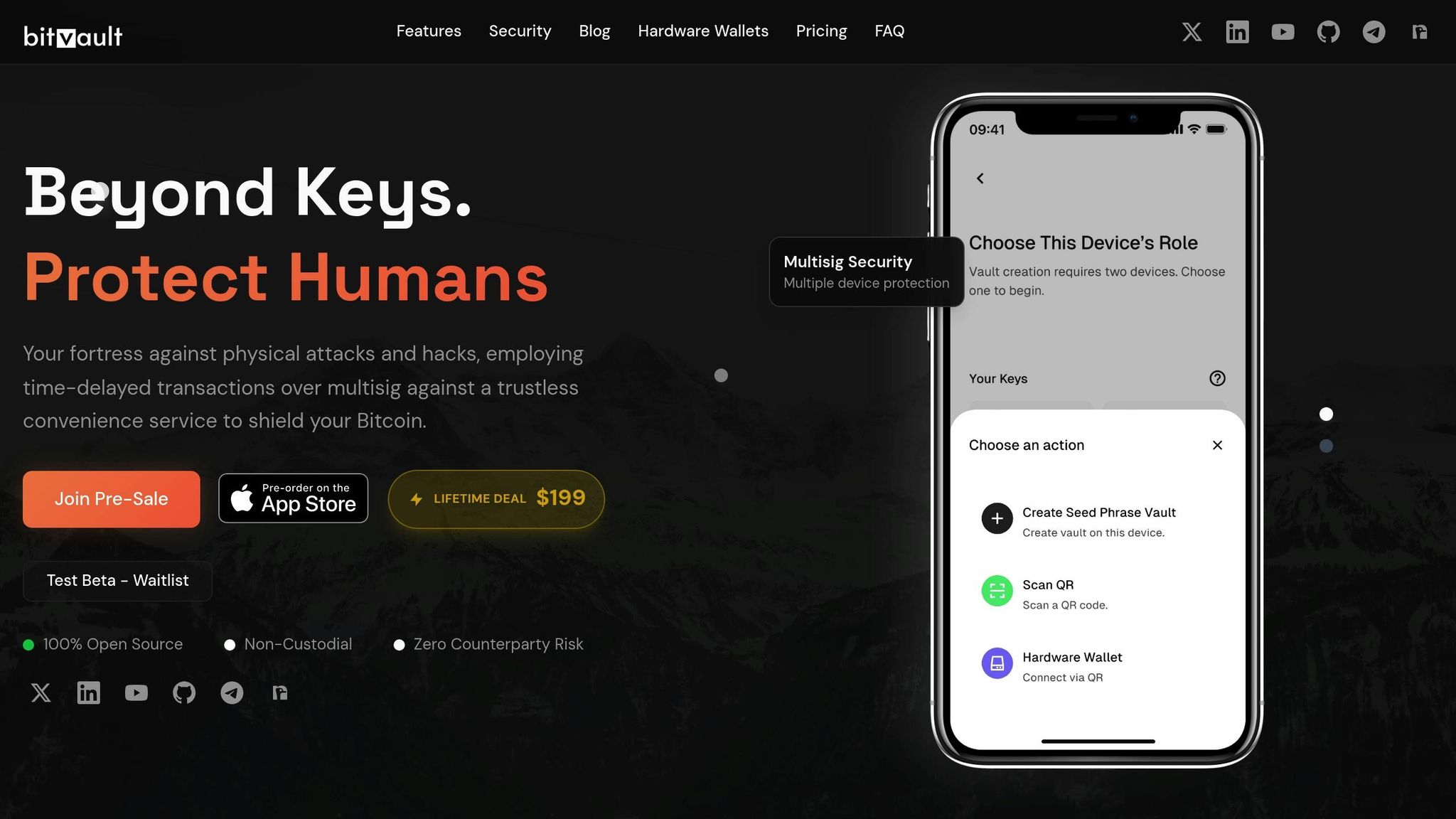
BitVault addresses many common backup challenges by combining advanced technology with user-friendly solutions. Its system strengthens security and simplifies recovery, making it a reliable choice for descriptor backups.
BitVault uses AES 256-bit encryption to protect data stored on the Bitcoin blockchain, ensuring that only authorized users can access it. It also integrates with Bitcoin Layer 2 solutions like the Liquid Network and the Lightning Network, offering flexible and cost-effective storage options, especially when network fees fluctuate.
For added security, BitVault includes time-delayed transactions. This feature provides a window to detect and prevent unauthorized access attempts – an especially useful safeguard for inheritance scenarios where multiple stakeholders may need access.
As an open-source platform, BitVault benefits from community support and transparency. This ensures ongoing improvements and adaptability, making it a dependable solution for long-term descriptor management and recovery planning.
sbb-itb-c977069
Encryption and Recovery Steps for Descriptors
Encryption transforms vulnerable descriptor backups into secure, recoverable assets. The challenge lies in balancing strong security with practical access when you need to retrieve your Bitcoin.
Secure Encryption Methods
Symmetric encryption is one of the simplest and most effective ways to secure your descriptors. By using AES-256 encryption with a strong passphrase, you create a solid defense against unauthorized access. Think of the passphrase as your master key – it should be complex enough to resist brute-force attacks but still memorable. A mix of random words, numbers, and symbols works best, but steer clear of personal details like birthdays or names.
Public-key encryption takes a different approach, relying on asymmetric cryptography. Here, you generate a key pair specifically for encrypting your backup. The public key encrypts the descriptors, while only the matching private key can decrypt them. This method is particularly useful for inheritance planning since you can share the encrypted backup widely without risking the private key.
Shared secret schemes offer another layer of protection by splitting the encryption key among multiple parties or locations. For example, Shamir’s Secret Sharing allows you to divide the key into parts, requiring a minimum number – like 3 out of 5 key holders – to reconstruct it. This eliminates single points of failure while ensuring that no single individual can access your funds independently.
AES-256 encryption is widely regarded as unbreakable with current technology, offering a high level of protection. To enhance password-based encryption, ensure your software uses strong key derivation functions like PBKDF2 or Argon2.
Once your descriptors are securely encrypted, you’ll need a clear plan for recovery.
Step-by-Step Descriptor Recovery
Recovering your wallet requires both the correct descriptor information and the necessary seed phrases from all required signers. Losing either can make recovery impossible, so meticulous attention to detail is critical.
1. Gather your essentials.
Start by collecting all required seed phrases from the involved signers. For example, in a 2-of-3 multisig setup, you’ll need at least two complete seed phrases. Locate your encrypted backup and confirm you have the necessary decryption method – whether that’s a passphrase, private key, or reconstructed shared secret.
2. Decrypt your backup.
Use the original software and method to decrypt your backup. If you’ve stored the encrypted backup on-chain (e.g., using BitVault), retrieve it from the blockchain and apply your decryption key. Once decrypted, verify the descriptor by checking for recognizable elements like key origins, derivation paths, and the multisig threshold.
3. Import seed phrases and descriptors.
Most Bitcoin wallet software supports descriptor imports, but ensure the one you use can handle your specific multisig setup. Import each seed phrase individually, following the correct order and derivation paths outlined in your descriptor. For instance, a descriptor for a 2-of-3 multisig wallet might look like this:
wsh(sortedmulti(2,[fingerprint/path]xpub...[fingerprint/path]xpub...))
The descriptor will guide the wallet software in generating addresses and identifying transactions. Once imported, the software should begin scanning for your transaction history.
4. Confirm wallet reconstruction.
Check that your wallet reflects the correct balance and transaction history. Generate a few receiving addresses and compare them to those you’ve used in the past. This step ensures everything is set up correctly before moving forward.
5. Test with a small transaction.
Before transferring large amounts, send a small test transaction to verify that the wallet functions as expected. This precaution reduces risk and confirms that the recovery process was successful.
Platforms like BitVault simplify this recovery process. By storing encrypted descriptors on-chain, BitVault ensures your backup remains accessible even in the face of physical disasters or hardware failures. Additionally, their time-delayed transaction feature adds an extra layer of security. This feature gives you time to verify that everything is working properly before handling larger transactions.
Careful verification at every step is crucial to avoid irreversible loss of funds.
Cross-Chain Recovery and Inheritance Planning
The Bitcoin ecosystem has grown far beyond its original blockchain, incorporating networks like Liquid and Lightning. Multisig wallets often span these networks, making descriptor backups essential for recovery across multiple platforms. Below, we’ll explore strategies for both cross-chain wallet recovery and inheritance planning.
Cross-Chain Wallet Recovery
For wallets that operate across Bitcoin’s mainnet, Liquid, and Lightning networks, descriptor backups are indispensable. These descriptors store the critical configuration details needed to reconstruct your wallet on compatible platforms.
Recovering a wallet on Bitcoin’s mainnet is relatively straightforward, but adding cross-chain setups introduces complexity. For instance, if you’re using a 2-of-3 multisig wallet that spans mainnet and Lightning, you’ll need to ensure your seed phrases and descriptors are intact and that your recovery software supports both networks.
The Liquid Network adds another layer of complexity. While Liquid uses Bitcoin’s cryptographic principles, it operates as a sidechain with faster transaction settlements. Properly formatted descriptors enable seamless recovery across Bitcoin, Liquid, and Lightning. BitVault addresses this challenge by integrating with Bitcoin’s Layer 2 solutions, allowing recovery from a single backup.
Cross-chain recovery is especially critical during emergencies. If your primary wallet software fails or becomes inaccessible, having formatted descriptors ensures compatibility with alternative software that supports your multisig setup.
Planning for Inheritance
Inheritance planning for Bitcoin presents unique challenges that traditional estate planning often overlooks. Beneficiaries need more than just your seed phrases and descriptors – they require clear, actionable instructions to use them securely.
A 2020 Cremation Institute study revealed that while 89% of cryptocurrency investors worry about their assets after death, only 23% have a documented plan, and a mere 7% include cryptocurrencies in their wills [3]. This gap often stems from the technical complexity involved in managing digital assets.
Just as descriptor backups protect your funds, proper inheritance planning ensures that protection extends to your heirs. One effective strategy is to divide responsibilities among trusted individuals. For example, one family member might hold two seed phrases from your multisig wallet, while another holds the descriptor backup and the remaining seed phrase. This approach prevents any single person from accessing the funds independently.
Documentation is key. Beneficiaries should have step-by-step guides for recovery, including which software to use, how to decrypt backups, and the correct sequence for importing seed phrases and descriptors. What seems straightforward to you may be entirely unfamiliar to your heirs.
Legal considerations are equally important. Your inheritance plan should align with jurisdictional requirements for transferring digital assets. Some regions require specific language in wills to address cryptocurrency holdings, so integrating technical and legal plans is essential.
Timing is another factor. If your multisig setup includes time-delayed transactions or requires multiple approvals, beneficiaries must understand these mechanisms. For instance, if there’s a 48-hour delay for transactions to finalize, heirs unaware of this protocol might panic when funds don’t transfer immediately.
BitVault’s Role in Cross-Chain and Inheritance Security
BitVault offers tools to simplify the complexities of cross-chain recovery and inheritance planning. Its time-delayed transaction feature provides a safety net for inheritance transfers and recovery processes.
Decentralized backup storage is another key feature. By storing encrypted descriptors on-chain, BitVault eliminates the risk of losing physical backups. Even if hardware fails, your recovery data remains accessible.
BitVault’s guardian-based inheritance system adds another layer of security. You can appoint trusted individuals as guardians who collectively approve inheritance requests. This system uses trigger-based access, where assets unlock only after specific conditions – such as incapacitation or death – are met [2].
To prevent premature access, BitVault includes a preemptive veto feature. If a beneficiary attempts to access assets inappropriately, you have a set period (typically 48 hours) to cancel the request [2].
Finally, BitVault employs AES 256-bit encryption to secure on-chain backups. Even if the backup becomes public, the encrypted data remains protected. Beneficiaries need both access to the backup and the decryption method, ensuring an extra layer of security.
Key Takeaways
To securely store Bitcoin, multisig wallets and descriptor backups are indispensable. Relying solely on seed phrases isn’t enough, as they don’t account for the full wallet configuration.
The complexity grows when dealing with multiple networks. If you operate across Bitcoin’s mainnet, Liquid, and Lightning, descriptor backups are vital to ensure smooth recovery across all networks. This becomes even more critical during emergencies, like when your primary wallet software fails or becomes inaccessible.
Planning for inheritance and asset transfer is just as important. Clear documentation and shared responsibilities are necessary to help beneficiaries recover funds safely and accurately.
BitVault simplifies these challenges by offering features like integrated cross-chain support, time-delayed transactions, and AES 256-bit encrypted on-chain backups. These tools make recovery and inheritance more manageable.
To protect your funds, always test your backups, document recovery steps clearly, and plan ahead. Proper backups are the cornerstone of secure Bitcoin management.
FAQs
What’s the difference between single-signature and multisig wallets, and why are descriptor backups important for multisig setups?
Single-signature wallets use just one private key to approve transactions. While this setup is straightforward, it comes with a significant downside: if the key is lost or stolen, your funds could be in jeopardy. Multisig wallets, however, add an extra layer of protection by requiring multiple private keys to authorize a transaction. This approach minimizes the risk of losing access due to a single point of failure.
For multisig wallets, descriptor backups are crucial. These backups save the detailed configuration of your wallet, outlining how the keys work together. With this information, you can recover your wallet even if some keys are lost or compromised, ensuring your Bitcoin remains accessible and secure in critical situations.
How can I make sure my Bitcoin wallet is recoverable if a co-signer is unavailable or loses their data?
To make sure you can recover your Bitcoin wallet even if a co-signer is unavailable or loses access, it’s important to securely store all seed phrases and private keys. In a multisig setup, you usually need a specific number of keys (like 2 out of 3) to regain access. To protect against loss, keep these backups in separate, secure locations.
Another useful tool for recovery is descriptor backups. These contain key details like master fingerprints and extended public keys (xpubs), which help rebuild your wallet and retrieve funds, even across different platforms, including Bitcoin Layer 2 solutions. By carefully managing these backups, you can ensure your wallet stays accessible, no matter what challenges arise.
What are the best practices for ensuring your Bitcoin assets can be inherited using multisig wallets and descriptor backups?
To make sure your Bitcoin assets are passed down securely and without hassle, consider setting up a multisignature (multisig) wallet – a 2-of-3 configuration is a good option. With this setup, you can divide the keys between yourself, a trusted heir, and a reliable third party, like an attorney. This way, no single person has full control, but recovery is still possible when needed.
It’s also crucial to create and safely store descriptor backups and seed phrases. Use tamper-proof storage methods to keep these backups secure, and distribute them thoughtfully. By combining a strong multisig wallet with carefully managed backups, you can safeguard your Bitcoin while ensuring your heirs can access it when necessary.