

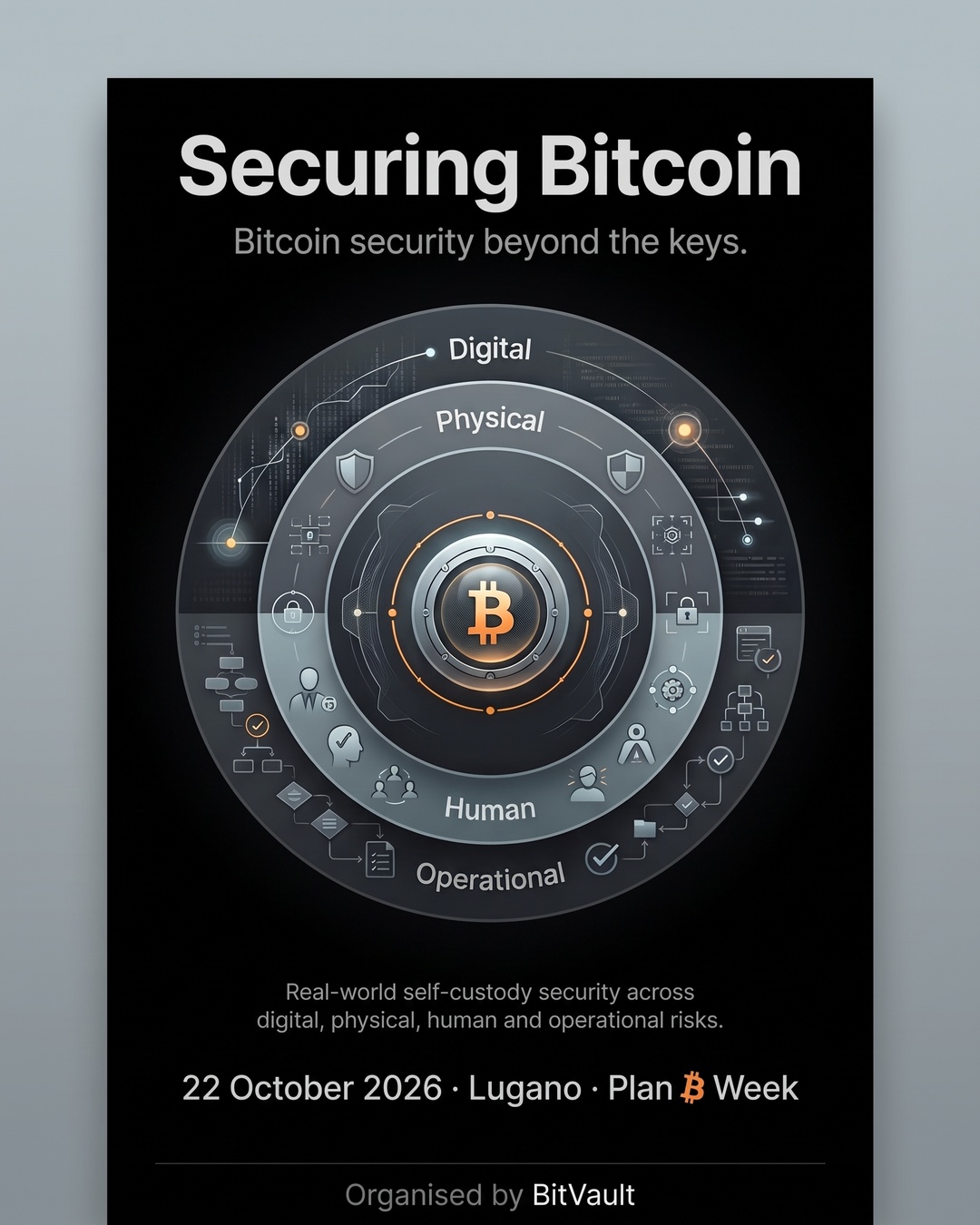
Securing Bitcoin: Beyond the Keys — Join Us in Lugano on October 22
Bitcoin self-custody gives you control. But protecting your keys is only the beginning.
You can use a hardware wallet. Back up your seed correctly. Keep your devices offline.
And still have things go wrong.
What happens if the device you trust is compromised? If your privacy exposes you as a target? If the infrastructure you normally rely on becomes unavailable? If recovery works technically but fails when your family actually needs it? Or if someone can force you to initiate a transaction?
These are not questions about whether self-custody works.
They are questions about what secure self-custody looks like in the real world.
On October 22 in Lugano, BitVault is bringing together Bitcoin builders, security specialists and practitioners for Securing Bitcoin, a half-day event dedicated entirely to that question.
Self-custody security goes beyond the seed phrase
Most conversations about Bitcoin security start with private keys.
They should. But they should not end there.
Once you take responsibility for your bitcoin, security becomes a system involving devices, software, backups, privacy, communications, recovery procedures and, ultimately, people.
A strong setup therefore needs to survive more than a stolen seed.
Securing Bitcoin explores the broader failure modes that Bitcoin holders face: digital attacks, physical threats, human error, privacy leaks, operational failures and recovery breakdowns.
The objective is not to make self-custody more complicated.
It is to understand where it can fail, which risks actually matter, and which tools and security models can make those failures less catastrophic.
From hardware wallets to recovery and inheritance
The programme approaches the problem from different angles.
On the technical side, the discussion will explore areas such as hardware-wallet trust, privacy, Bitcoin vaults, transaction broadcasting, multisig coordination and layered security.
But technology is only part of the problem.
The programme will also look at everyday operational security, Lightning, recovery, inheritance and the human decisions that determine whether a security model still works outside ideal conditions.
Rather than treating each topic in isolation, the event is designed to connect them.
Because a secure hardware wallet does not solve a bad recovery plan. A strong multisig setup does not automatically protect your privacy. And a technically sophisticated architecture is of limited value if the people who depend on it cannot use it when something goes wrong.
Twelve perspectives on one problem
Securing Bitcoin brings together speakers such as Schnuartz, Jaromil, Roos, Super Testnet, Rafael Turon, Luke de Wolf, Joe Nakamoto, Max Musumeci, Chris Seedor, Darko Gasic, Alexandre Poltorak and Knut Svanholm.
The format combines focused talks with moderated discussions, bringing together both technical and non-technical perspectives.
The intention is not to promote one prescribed way of securing bitcoin.
It is to give participants enough context to understand the trade-offs themselves: what you are trusting, where your setup can break and what alternatives exist when one layer fails.
You don’t need to be a security engineer
Securing Bitcoin is designed for people who already understand why self-custody matters but want to understand its security more deeply.
You do not need to be a cybersecurity professional.
If you hold bitcoin yourself, are improving your setup, work on Bitcoin products or simply want to understand how experienced practitioners think about security when real money is at stake, the programme is designed to give you a clearer framework for making those decisions.
The goal is simple:
understand what can actually go wrong, what you can do about it, and how stronger Bitcoin security can remain usable.
Join us in Lugano
Securing Bitcoin — by BitVault
October 22, 2026
13:30–19:00
Lugano Dante, Piazza Cioccaro 5, Lugano
If you are going to be in Lugano during Plan ₿ Week and self-custody matters to you, reserve your place. Seats are limited.
Bitcoin security goes beyond the keys.