Bitcoin security beyond the keys: BitVault in Lugano
More than 100 people joined BitVault’s Securing Bitcoin event in Lugano. Explore the talks, audience questions and hands-on B-SSL workshop at Spazio 21.

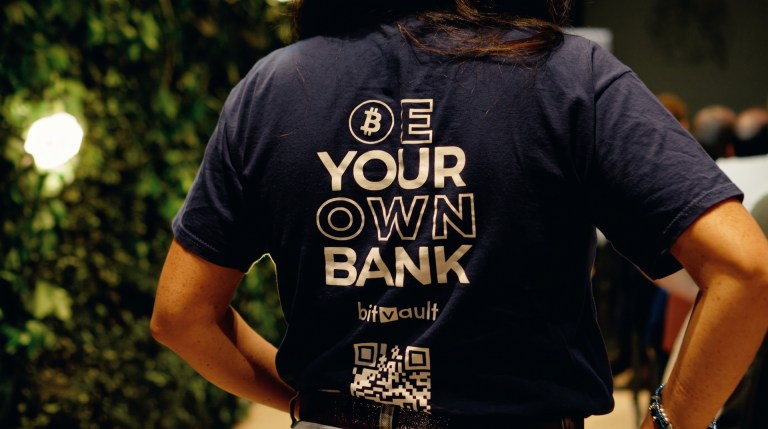
More than 100 people joined BitVault’s Securing Bitcoin event in Lugano. Explore the talks, audience questions and hands-on B-SSL workshop at Spazio 21.

Bitcoin self-custody gives you control. But protecting your keys is only the beginning. You can use a hardware wallet. Back up your seed correctly. Keep your devices offline. And still have things go wrong. What happens if the device you trust is compromised? If your privacy exposes you as a target? If the infrastructure you…
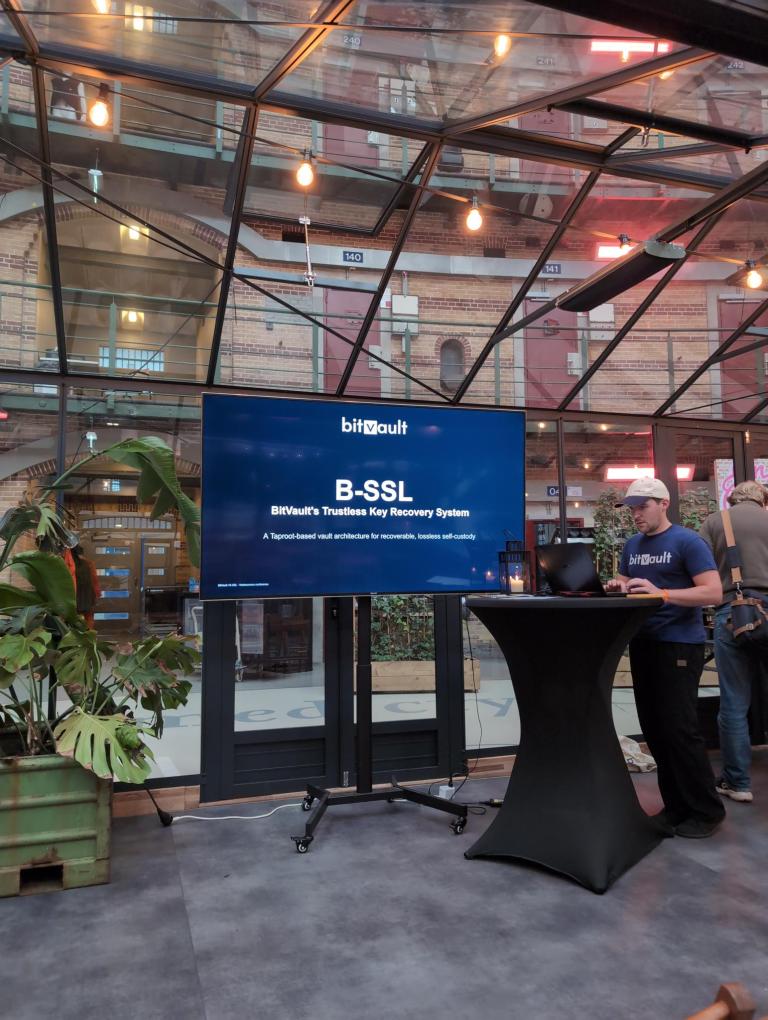
What happens to a Bitcoin vault when one of its keys is compromised? And what if a key becomes unavailable instead? At Noderunners Conference in Arnhem, we turned those questions into an interactive experiment thanks to our lead developer Riccardo. During When Things Go South: The B-SSL Vault Challenge, BitVault Lead Developer Riccardo Biffi walked…
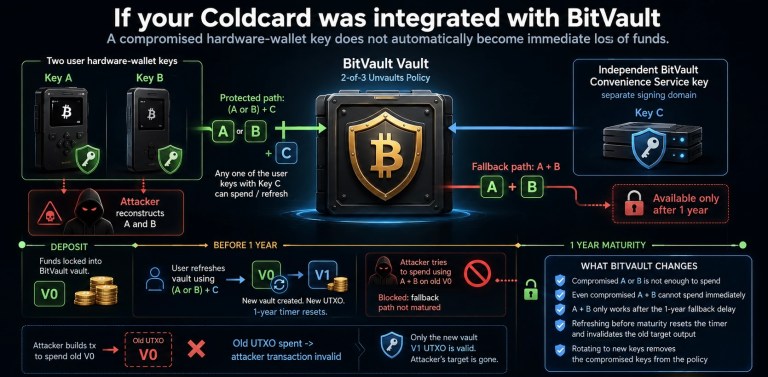
If your Coldcard was integrated with BitVault, reconstructing its defective private key would not, by itself, have given the attacker immediate control over your bitcoin. More importantly, this remains true even in the stronger failure scenario: suppose the user created both BitVault user keys using two affected Coldcards, and the same randomness defect allowed an…
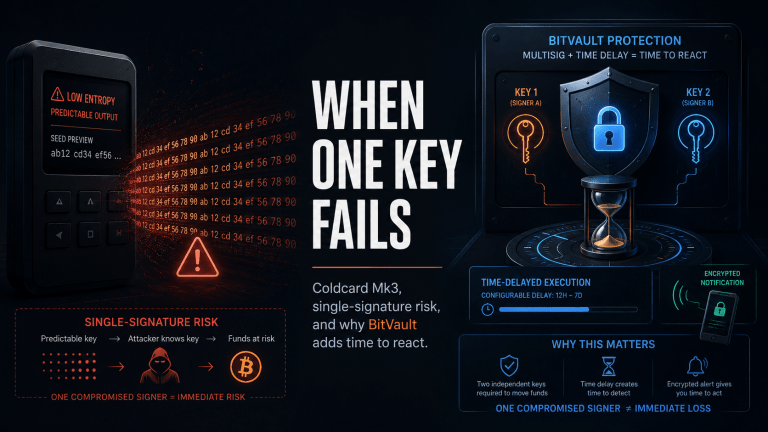
The Coldcard incident shows how weak key generation can defeat an air-gapped wallet. We examine what multisig and time-delayed BitVault security mitigate — and what they do not.

By mordom A Bitcoin address is not a public key. For most users, an address looks like a random string. Something you copy, paste, and use to receive funds. But behind those characters lies a very precise chain of cryptographic transformations. Nothing is arbitrary. Each step exists for a specific reason: security, compactness, resilience, and long-term…

By mordom Imagine a normal situation. You have a hardware wallet. You want to monitor activity without plugging it in every time. Or you need to share addresses with your accountant. Or you’re using a watch-only app.So you export a zpub (an extended public key) and share it. The assumption is simple: “I’m only sharing public…

By mordom Your wallet does NOT generate infinite addresses You send a transaction. The wallet says “sent.”Then you wait.After an hour it’s still unconfirmed. After a few hours you start to worry.The exchange doesn’t credit, the payment doesn’t arrive, the recipient messages you.At that point, it feels like there’s nothing you can do. In reality, you…

By mordom Open your wallet and you see a number.0.42 BTC.1.8 BTC.0.003 BTC. It looks like a bank account. A single balance that belongs to you.But that number does not exist on the blockchain. Bitcoin does not track accounts or balances per address. There is no global registry that says “this address owns X”. What…

By mordom Anyone who owns Bitcoin is familiar with the 12 or 24 words.We call them a “seed phrase”.But they are not the seed. And this is where one of the most common misunderstandings begins: many people confuse the mnemonic (BIP39) with the actual cryptographic seed. The words are a human-readable representation of the original…