


Miniscript Policies for Multisig Nodes
Bitcoin multisig wallets have traditionally relied on rigid scripts to define transaction conditions. But Miniscript offers a simpler, clearer way to manage these rules while staying fully compatible with the Bitcoin network. It provides more flexibility, better error prevention, and easier wallet compatibility compared to standard multisig scripts.
Here’s what you need to know:
- Miniscript: Allows for more advanced rules like time-based restrictions and recovery options, reducing implementation errors.
- Standard Multisig: Straightforward and widely supported but lacks the ability to handle complex or changing needs.
Quick Takeaway: If you need dynamic, secure, and customizable spending rules, Miniscript is a better choice. But if simplicity and ease of use are your priorities, standard multisig scripts remain a reliable option.
Miniscript – Open Source Stage – Bitcoin 2023
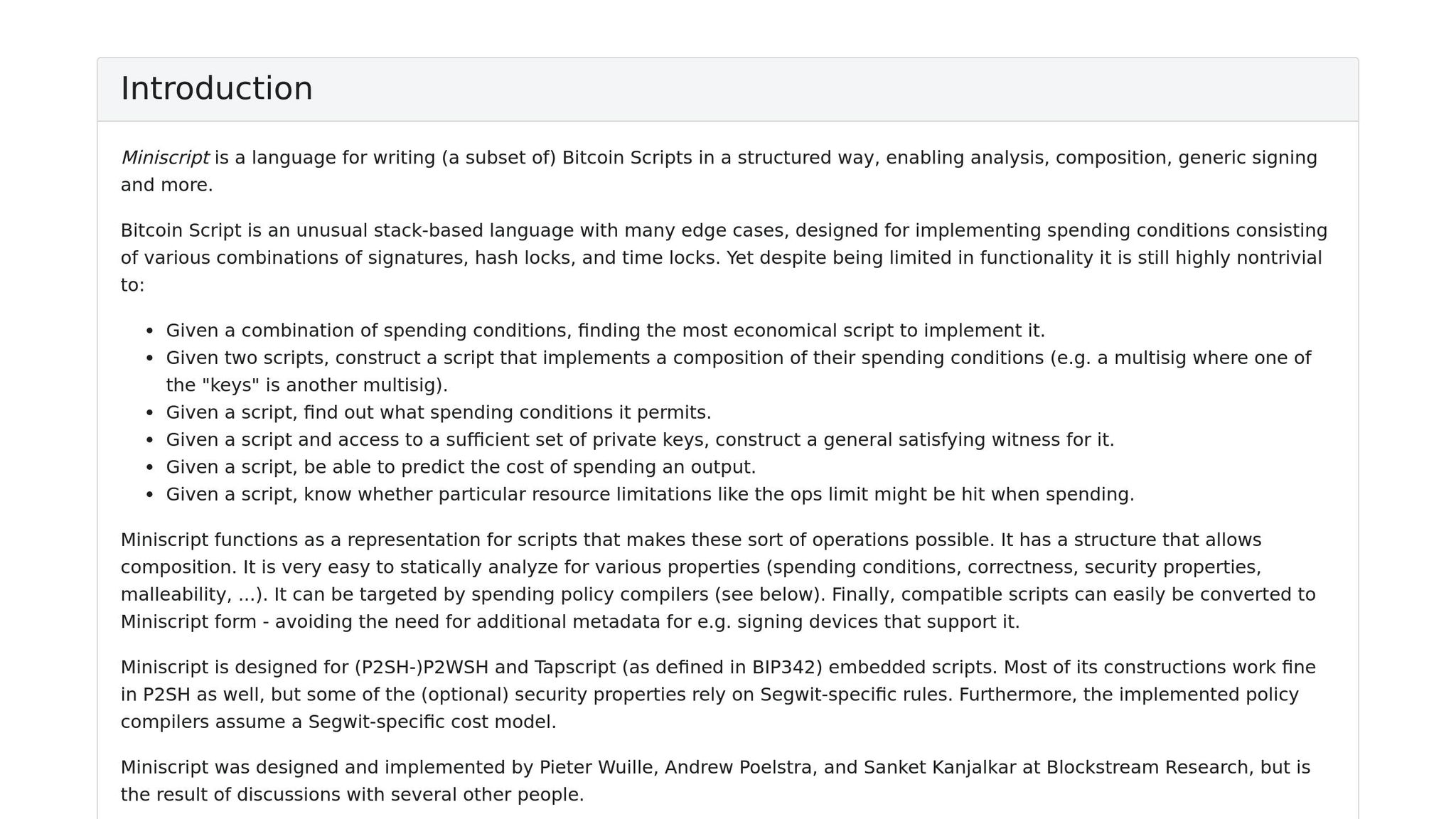
1. Miniscript-Based Multisig Policies
Miniscript brings a fresh approach to defining multisig spending conditions in Bitcoin operations. Unlike traditional multisig scripts, which rely on fixed templates, Miniscript offers a more adaptable way to outline spending rules. Let’s dive into what makes Miniscript policies stand out compared to conventional multisig methods.
Policy Formulation
With Miniscript, developers can create more nuanced spending conditions using a unified format. This flexibility allows for complex multisig setups that go beyond the typical 2-of-3 or 3-of-5 configurations. For instance, it can incorporate time-based restrictions, hierarchical key arrangements, or conditional spending paths – all within a single policy. This versatility enhances the potential for stronger security measures.
Security Considerations
The structured and explicit nature of Miniscript helps reduce errors during implementation. Its standardized syntax makes it easier to verify and audit spending conditions, lowering the risk of vulnerabilities that can arise when manually building intricate Bitcoin scripts. This clarity simplifies testing and ensures that multisig configurations are both reliable and secure.
Interoperability
Miniscript’s standardized framework promotes compatibility across different Bitcoin wallets. Wallets from various providers can interpret and execute the same advanced spending conditions without needing custom integrations. This seamless communication between systems makes it easier for users to work across different wallet platforms.
Recovery Mechanisms
Miniscript also opens the door to more advanced recovery options in multisig setups. For example, it can support features like time-delayed backup keys, fallback mechanisms with reduced security, or conditional recovery paths that activate under specific scenarios. These options provide users with greater protection against the risk of losing access to their funds.
2. Standard Multisig Scripts
Standard multisig scripts are built around a straightforward concept: a specific number of signatures (like 2-of-3 or 3-of-5) are required to approve a transaction. This traditional model is easy to understand and widely used, but it contrasts sharply with the added flexibility offered by Miniscript.
Policy Flexibility
The simplicity of standard multisig scripts is both their strength and limitation. They clearly define the number of required signatures and identify the public keys for each signer. However, this rigid structure doesn’t cater well to more intricate conditions. If you need advanced functionality, additional scripting becomes necessary, which can complicate things.
Security Features
One of the key advantages of standard multisig scripts is their ability to spread signing authority. By requiring multiple keys, they minimize the risk of single-point failures. For an attacker to succeed, they would need to compromise several keys, making unauthorized transactions significantly harder. That said, once the script is set, its parameters are locked in. Adjustments require creating a new address and transferring funds, which can be inconvenient.
Interoperability
Standard multisig scripts are widely supported across the Bitcoin ecosystem. Most wallets and services are designed to handle common multisig setups, ensuring they work seamlessly on various platforms. However, when you venture into less common or highly customized configurations, compatibility issues may arise, as not all implementations handle nonstandard scripts the same way.
Recovery Options
Recovery in standard multisig setups depends on access to the required keys. For instance, in a 2-of-3 setup, losing one key doesn’t spell disaster – you can still authorize transactions with the remaining two. This highlights the importance of good key management and secure backups. Since the recovery process is tied directly to the original threshold, losing too many keys could render funds inaccessible. Proper planning is essential to avoid such risks.
sbb-itb-7e890ce
Pros and Cons
When deciding on a multisig policy for your Bitcoin node operations, it’s essential to consider the balance between flexibility and simplicity.
Flexible policies provide broader spending conditions, which can be a big advantage for organizations with dynamic needs. However, this approach requires a higher level of technical expertise. Customizing these policies can be challenging to implement and troubleshoot, making careful design and thorough review critical to avoid potential operational hiccups.
On the other hand, standard multisig setups are known for their straightforward nature. They’re easier to implement, audit, and maintain, which makes them appealing for those prioritizing reliability over complexity. However, their fixed requirements can limit adaptability, as any new operational demands might require address changes.
Ultimately, the choice between a flexible policy and a standard multisig setup depends on your specific operational needs and technical capabilities. For those with evolving requirements, flexibility might be the way to go. Meanwhile, organizations prioritizing simplicity and proven reliability might find standard multisig scripts a better fit.
Conclusion
Miniscript-based policies offer a powerful way to manage multisignature operations, especially in setups where requirements are expected to change over time. Their adaptability makes them a great fit for dynamic environments, though the actual advantages depend heavily on how they are implemented.
On the other hand, for organizations with straightforward security requirements and limited resources, standard multisig scripts remain a reliable choice. Their long-standing support within Bitcoin operations ensures stability and ease of use.
Ultimately, deciding between Miniscript-based policies and traditional multisig scripts comes down to evaluating your current security priorities and long-term objectives. Both approaches play an important role in creating a strong, layered defense for Bitcoin assets.
FAQs
What benefits does Miniscript offer compared to standard multisig scripts in Bitcoin operations?
Miniscript brings a range of benefits to Bitcoin operations, offering a more flexible, secure, and user-friendly approach compared to standard multisig scripts. By introducing a structured and programmable framework, it simplifies the creation and analysis of complex spending policies, ensuring they are efficient and less prone to errors.
One standout advantage is its enhanced compatibility and adaptability. Miniscript enables dynamic spending policies that can adjust to different scenarios – for example, requiring specific sets of signatures based on conditions like time delays or emergencies. This flexibility makes it particularly useful for handling varied and unpredictable situations.
Another key strength lies in its improved security and auditability. Miniscript makes it easier to verify and understand the logic behind a script, which helps reduce risks tied to vulnerabilities or misconfigurations. This transparency is crucial for building trust in complex Bitcoin operations.
In short, Miniscript boosts the usability and reliability of multisig wallets, making it a powerful tool for advanced Bitcoin use cases and secure wallet management.
How does Miniscript improve security and reduce errors in multisig wallets?
Miniscript improves the security and reliability of multisig wallets by offering a structured, programmable way to create scripts. It streamlines the process of setting up complex spending conditions, making it easier to verify and review scripts for potential weaknesses.
By minimizing the chances of human error during script design and ensuring smooth compatibility with Bitcoin nodes, Miniscript provides a safer and more accessible approach to managing multisig wallets. This is especially useful for safeguarding large Bitcoin holdings and establishing advanced access controls.
How does Miniscript improve multisig wallet functionality, and can it be integrated with existing Bitcoin wallets?
Miniscript improves the functionality of multisig wallets by streamlining the process of creating and analyzing Bitcoin scripts. This makes it simpler to design spending conditions that are both secure and adaptable. By offering a standardized approach to expressing policies, it cuts down on complexity and boosts compatibility across various wallets and tools.
While Miniscript can be incorporated into existing Bitcoin wallets, how easily it integrates depends on the wallet’s architecture and its support for advanced scripting features. Wallets built with flexibility and extensibility in mind are better positioned to adopt Miniscript smoothly, enhancing both their interoperability and security.
Related Blog Posts
- How to Set Up a Bitcoin Multisig Wallet
- Sparrow Wallet Multisig Setup: Secure Bitcoin Storage
- Ultimate Guide to Bitcoin Transaction Security
- Never leave Bitcoin on Exchanges, Learnings from Bitcoin7.com Hack in 2011
https://app.seobotai.com/banner/banner.js?id=68fc1ba19cea6427b3fd9420