


Threshold Signatures vs OP_CHECKMULTISIG
When deciding how to secure Bitcoin transactions with multiple approvals, two main options stand out: OP_CHECKMULTISIG and threshold signatures. Both achieve the same goal – requiring multiple signatures – but differ in their approach, efficiency, and privacy.
- OP_CHECKMULTISIG: Relies on Bitcoin’s scripting language, making all public keys and signature thresholds visible on the blockchain. While reliable, it results in larger transaction sizes, higher fees, and reduced privacy.
- Threshold Signatures: Uses advanced cryptography to combine multiple signatures into one. This method keeps the multisig setup private, reduces transaction size, lowers fees, and improves scalability, though it requires off-chain coordination.
Quick Comparison
| Feature | OP_CHECKMULTISIG | Threshold Signatures |
|---|---|---|
| Privacy | Low (setup is visible) | High (appears standard) |
| Transaction Size | Larger | Smaller |
| Fees | Higher | Lower |
| Key Exposure | All keys are visible | Only one aggregated key |
| Blockchain Impact | More data stored | Minimal data footprint |
| Ease of Use | Simpler on-chain setup | Requires off-chain setup |
Key takeaway: Choose OP_CHECKMULTISIG for simplicity and transparency, or threshold signatures for privacy, lower fees, and scalability.
Exploring Threshold Security Methods for Bitcoin
How OP_CHECKMULTISIG Works
OP_CHECKMULTISIG, one of Bitcoin’s early features, allows transactions to require multiple signatures for approval, spreading trust across several participants. Here’s a closer look at how it functions and the challenges it presents.
How OP_CHECKMULTISIG Operates
In a multisignature transaction using OP_CHECKMULTISIG, a set of public keys is included alongside a required signature threshold. For the transaction to proceed, the network checks if the necessary number of valid signatures matches the predefined rules. This ensures that only when the agreed number of participants approves can the transaction be finalized.
Challenges with OP_CHECKMULTISIG
Despite its reliability in securing transactions, OP_CHECKMULTISIG comes with a few drawbacks. Multisignature transactions often result in larger transaction sizes, leading to higher fees. Additionally, creating and verifying these scripts can be complex, placing extra demands on wallet software and transaction processing.
Because of these challenges, alternatives like threshold signatures are being explored. These newer methods aim to improve efficiency and scalability without compromising security.
How Threshold Signatures Work
Threshold signatures represent a modern cryptographic solution designed to overcome many of the challenges associated with OP_CHECKMULTISIG. Unlike traditional multisignature setups that expose multiple public keys on the blockchain, threshold signatures generate a single, unified signature that looks no different from a standard Bitcoin transaction.
Threshold Signature Process
Threshold signatures build upon the principles of multisignature systems but streamline the process significantly. This method relies on advanced cryptography, allowing multiple participants to collaborate in creating a single signature without exposing their individual contributions on-chain.
The process begins with participants generating their private keys and corresponding public key shares through a distributed key generation protocol. When a transaction needs to be signed, each participant uses their private key share to create a partial signature. These partial signatures are then combined mathematically into one unified signature that validates against a single public key.
What’s unique here is that the entire process happens off-chain. The blockchain only records the final aggregated signature, which appears identical to a standard single-signature transaction. The threshold requirement – such as needing approvals from multiple parties – is enforced cryptographically, not through visible on-chain scripts. This "scriptless" design simplifies transactions while maintaining high security standards.
Threshold Signature Benefits
Threshold signatures deliver several clear advantages over OP_CHECKMULTISIG implementations:
- Smaller On-Chain Footprint: Transactions using threshold signatures are indistinguishable from regular single-signature transactions. This results in smaller transaction sizes, which are more cost-effective.
- Enhanced Privacy: Since the multisignature setup remains hidden, observers cannot tell whether a transaction involved multiple approvals or just one. This added privacy helps protect Bitcoin wallets from becoming targets for attackers who might otherwise identify high-value multisignature setups.
- Improved Scalability: Threshold signatures use far less block space compared to OP_CHECKMULTISIG transactions. For instance, a 2-of-3 threshold signature takes up the same space as a single-signature transaction, whereas a 2-of-3 OP_CHECKMULTISIG requires significantly more space due to the inclusion of multiple public keys and scripts.
- Lower Fees: Smaller transaction sizes translate directly into lower fees. This is particularly beneficial for frequent transactions or during times of high network congestion, making threshold signatures an efficient choice for regular multisignature operations.
- Seamless Compatibility: Because threshold signature transactions appear identical to standard ones, they integrate effortlessly with existing Bitcoin wallets, exchanges, and services. This eliminates the technical hurdles often associated with complex multisignature scripts and improves the overall user experience.
Security Model Comparison
OP_CHECKMULTISIG and threshold signatures both offer solid security but take very different approaches: one emphasizes on-chain transparency, while the other focuses on off-chain privacy. To choose the right solution, it’s important to understand how each handles common vulnerabilities and security challenges.
OP_CHECKMULTISIG Security Features
OP_CHECKMULTISIG leverages on-chain verification, ensuring transparent and predictable security. Every step of the verification process happens directly on the Bitcoin blockchain, making the transactions fully auditable by anyone in the network.
For example, in a common 2-of-3 multisignature setup, even if one private key is compromised, it’s not enough to authorize a transaction. The remaining keys still need to approve it, adding an extra layer of defense. Since the entire verification process relies on Bitcoin’s consensus mechanism and cryptographic standards, it benefits from the network’s established security.
On the other hand, threshold signatures take a different route, enhancing security by keeping the multisignature nature of transactions private.
Threshold Signature Security Features
Threshold signatures prioritize privacy by making multisignature transactions appear identical to standard single-signature transactions. This approach reduces the information visible to potential attackers.
Instead of exposing multiple public keys, threshold signatures produce a single aggregated key, making it harder for blockchain analysts to gather data. The unified signature structure also makes transactions less vulnerable to malleability issues.
However, threshold signatures require participants to coordinate off-chain to generate the final signature. This off-chain process depends on secure communication, but once the aggregated signature is created, the transaction is verified using Bitcoin’s standard mechanisms.
Here’s a quick comparison of the two approaches:
Security Comparison Table
| Security Aspect | OP_CHECKMULTISIG | Threshold Signatures |
|---|---|---|
| On-chain Privacy | Low – multisig setup is visible | High – appears as a single signature |
| Key Exposure | All individual keys are exposed | Only a single aggregated key is visible |
| Transaction Malleability | Standard resistance | Enhanced resistance |
| Key Compromise Recovery | Relies on multisig thresholds | Depends on secure key share management |
| Blockchain Analysis Resistance | Easier to identify multisig setups | Indistinguishable from standard transactions |
| Transparency | Fully auditable on-chain | Cryptographically verifiable but less transparent |
| Attack Surface | Larger due to public exposure | Reduced due to obscured signature details |
sbb-itb-7e890ce
Scalability and Transaction Efficiency
Making efficient use of blockchain space is critical for Bitcoin. The size of a transaction plays a big role in network congestion and fee costs, and how multisignature data is handled can significantly impact scalability.
Transaction Size Comparison
When using OP_CHECKMULTISIG, transactions include multiple public keys and individual signatures. Each of these elements – public keys, signatures, and the extra script data defining multisignature conditions – must be stored on the blockchain. This adds up quickly, increasing the overall transaction size.
On the other hand, threshold signatures take a different approach. They combine all the required signature information into a single signature that looks just like a standard Bitcoin transaction. This dramatically reduces the amount of data stored on the blockchain. The savings grow even more as the number of signatories increases, making threshold signatures a much more space-efficient option.
Fee Cost Analysis
Bitcoin transaction fees are based on the size of the transaction, not the value being transferred. This means smaller transactions lead to lower fees, which is especially helpful during times of high network activity. By reducing transaction sizes, threshold signatures can significantly lower fees, making them particularly appealing for frequent multisig operations.
Beyond individual savings, this smaller data footprint also benefits the broader network. Less block space is used, which can help reduce congestion and, in turn, lower fees for everyone.
However, there’s a trade-off. Threshold signatures require extra off-chain coordination among participants to create the aggregated signature. While this adds complexity, the savings in fees and reduced network congestion often make it worth the effort.
Use Cases and Applications
The way these methods scale and perform directly shapes where they shine best. Below, we explore how each method aligns with different security and usability needs.
When to Use OP_CHECKMULTISIG
OP_CHECKMULTISIG works best in scenarios where transparency, simplicity, and compatibility take center stage. Its clear and well-established structure is perfect for use cases like inheritance planning, where having defined signature thresholds makes decision-making straightforward. It’s also a solid choice for basic multi-user custody setups and organizational governance, thanks to its ease of implementation and widespread wallet support. However, if privacy or minimizing on-chain data is a priority, threshold signatures might be a better fit.
When to Use Threshold Signatures
Threshold signatures shine in situations where privacy and security are top priorities. By combining multiple signatures into a single, aggregated signature, this method hides the underlying multisignature arrangement. This added layer of privacy is especially appealing for users who want their security setups to stay discreet. What’s more, it achieves this without compromising on security, making it a powerful option for those who value both privacy and protection.
Choosing the Right Solution
When deciding between OP_CHECKMULTISIG and threshold signatures, it really comes down to your needs: simplicity and transparency versus privacy and efficiency. Both options offer strong security but shine in different scenarios.
Key Takeaways
OP_CHECKMULTISIG is straightforward, transparent, and widely supported. It clearly outlines signature requirements, making it ideal for cases like inheritance planning or organizational governance where multi-party approval needs to be clear and easy to manage.
Threshold signatures, on the other hand, combine multiple signatures into a single one. This reduces transaction size, cuts fees, and improves privacy by limiting on-chain disclosures. These features make threshold signatures a great choice for organizations that handle frequent multisignature transactions, as they significantly reduce costs and improve blockchain efficiency without compromising security.
The choice between these methods impacts wallet design and operational security, as demonstrated by solutions like BitVault.
BitVault‘s Role in Bitcoin Security
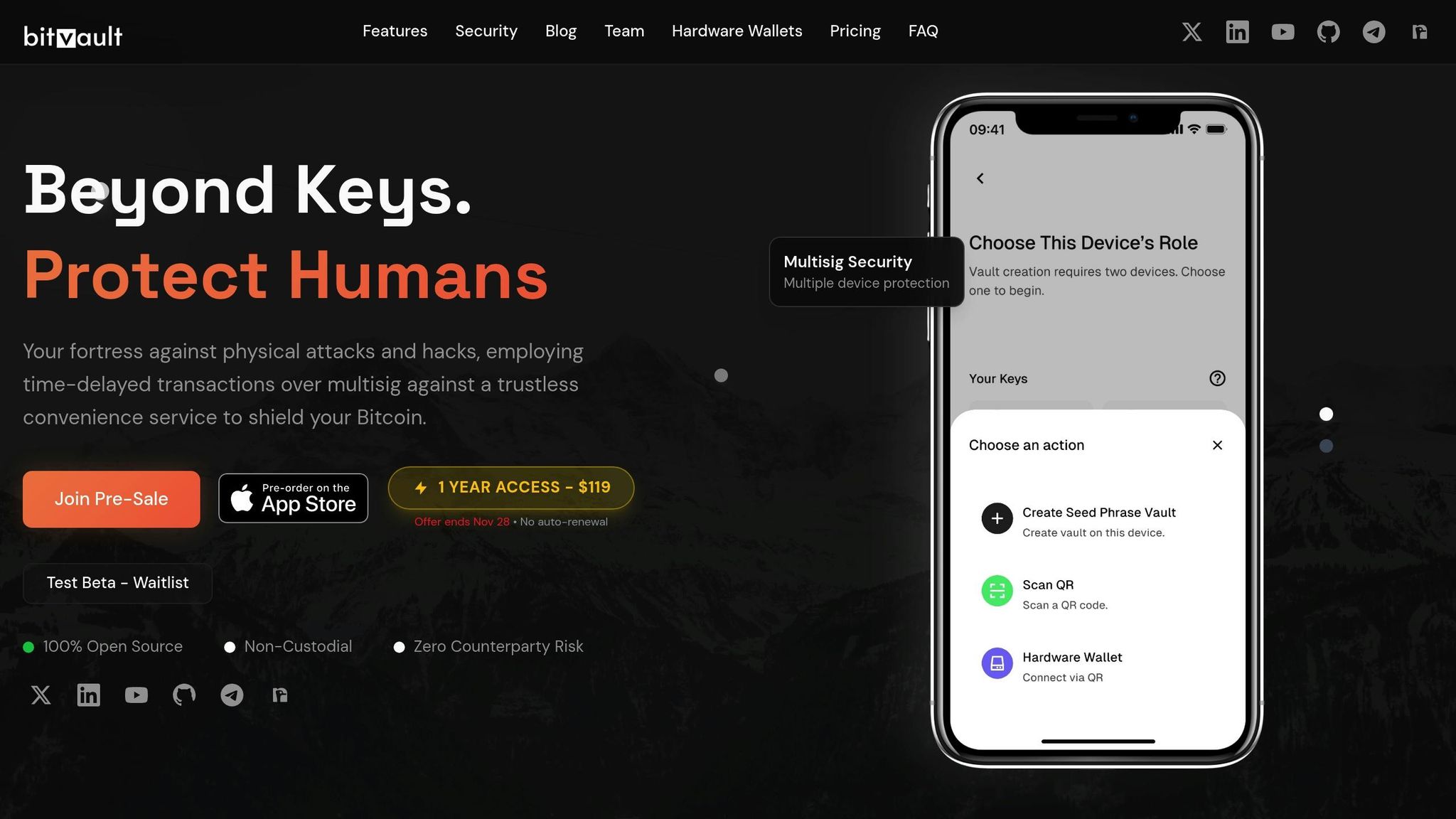
BitVault takes these concepts and applies them in practical, user-friendly ways to enhance Bitcoin security. For example, its time-delayed transactions add an extra layer of protection by introducing a mandatory review period before funds can be moved. This combines the strengths of multisignature setups with the added safeguard of time-based controls.
By integrating with hardware wallets like Jade Plus, BitVault shows how blending different technologies can create a more secure Bitcoin experience. Whether you’re using OP_CHECKMULTISIG or threshold signatures, BitVault’s non-custodial design ensures users retain full control of their private keys while benefiting from advanced security features.
Another standout is BitVault’s secret notification system, which discreetly alerts users during transactions. This is especially useful in threshold signature setups, where privacy is key, and confidential monitoring is essential.
Finally, BitVault’s open-source approach ensures transparency. Users can review how multisignature technologies are implemented, giving them confidence in the wallet’s reliability and security.
FAQs
How do threshold signatures improve privacy compared to OP_CHECKMULTISIG?
Threshold signatures (TSS) add a layer of privacy by making transactions appear just like standard single-signature transactions on the blockchain. In contrast to OP_CHECKMULTISIG, which exposes the number of participants in a multi-signature setup, TSS keeps this information hidden, offering users a higher degree of anonymity.
This privacy advantage is especially useful for Bitcoin wallets, as it helps protect sensitive details about the wallet’s structure and the individuals involved in the transaction.
What challenges might arise when using threshold signatures in Bitcoin wallets?
Implementing threshold signatures in Bitcoin wallets isn’t without its hurdles. One of the main challenges lies in the setup process. Participants need to securely generate and share their key shares, which demands advanced cryptographic expertise and reliable communication methods to maintain security throughout.
Another issue is compatibility. Not all Bitcoin wallets or services are equipped to support threshold signatures, potentially limiting their usability in some situations. While these signatures offer benefits like enhanced privacy and smaller transaction sizes compared to traditional multisig setups, they do come with a trade-off: higher computational demands, especially during the key generation and signing stages.
When might OP_CHECKMULTISIG be a better choice than threshold signatures, even with its larger transaction size and reduced privacy?
OP_CHECKMULTISIG is often a go-to choice when simplicity and broad compatibility take priority. As a native Bitcoin script operation, it operates without relying on extra cryptographic assumptions or external tools. This makes it easier to implement and verify, especially in environments with limited resources or for developers who value straightforward integration over more advanced functionalities.
This operation is also a practical option in scenarios where privacy and transaction size aren’t top priorities. For instance, it works well in smaller-scale applications or internal testing setups. Its simple design ensures it works seamlessly across a wide range of Bitcoin wallets and services, which can be a clear advantage in specific situations.
Related Blog Posts
- What Are Threshold Signatures in Bitcoin?
- Miniscript Policies for Multisig Nodes
- Top Bitcoin Privacy Enhancements with Miniscript
- Miniscript Threshold Signatures
https://app.seobotai.com/banner/banner.js?id=6917cd2160ed14ccdc7505d0